

Eczema, Psoriasis or Rosacea? How to Tell Them Apart
· Vivaldy Skin Clinic · View the Instagram post
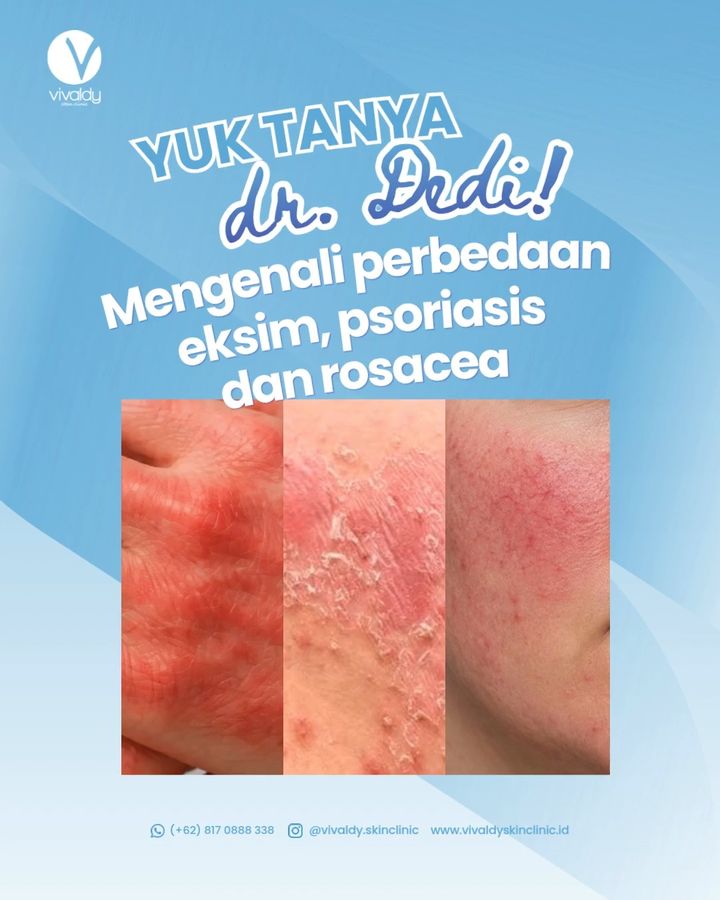
Many people assume any red or scaly skin problem must be eczema. Medically, though, eczema, psoriasis and rosacea are three very different conditions. They have different causes, so they need different treatment. Mistaking one for another can make the skin even more inflamed.
Eczema (atopic dermatitis)
Eczema happens when the skin barrier, the skin's protective layer, is damaged. The skin becomes very dry, red and intensely itchy. In adults, eczema often appears in skin folds such as the inner elbows and the backs of the knees. It often starts in childhood and can keep coming back.
Psoriasis
Psoriasis is an autoimmune condition: a problem with the immune system that makes skin cells form and pile up too quickly. It shows as red patches with clear edges, covered by thick, silvery scales. These patches often appear on the elbows, knees, scalp and lower back.
Important to know: psoriasis is not contagious. People living with it often face stigma, even though touching them cannot pass the disease on at all.
Rosacea
Rosacea usually appears in the centre of the face, such as the cheeks, nose, forehead and chin. Its signs are lasting redness, a face that flushes easily, fine blood vessels visible on the skin's surface, and sometimes small pimple-like bumps. The redness can be triggered by sun, heat, spicy food, hot or alcoholic drinks, and stress.
Quick comparison
| Eczema | Psoriasis | Rosacea | |
|---|---|---|---|
| Main cause | Damaged skin barrier | Immune system; skin cells pile up too quickly | Inflammation and reactive facial blood vessels |
| Common areas | Folds of the elbows and knees | Elbows, knees, scalp, lower back | Cheeks, nose, forehead, chin |
| Telltale signs | Very dry, red, intensely itchy | Sharply defined red patches, thick silvery scales | Lasting redness, easy flushing, pimple-like bumps |
| Contagious? | No | No | No |
Don't just reach for any ointment
Because they can look alike, these three conditions are often self-treated with over-the-counter ointments. But an ointment that suits one condition may not suit another. For example, a corticosteroid ointment used without a doctor's supervision, especially on the face, can actually make rosacea redness worse.
The safest approach is to confirm the diagnosis first. A dermatologist can tell these three conditions apart through an in-person examination and decide on the right treatment for your skin.
Related treatment at Vivaldy: Dermalight Therapy, light therapy for psoriasis and vitiligo.
This article is for education and does not replace an in-person examination by a doctor.